The Reproduction Rights Society of Nigeria has taken its national copyright advocacy campaign to the South-West, warning that the unauthorised reproduction of books, articles and creative works in tertiary institutions will no longer be tolerated.
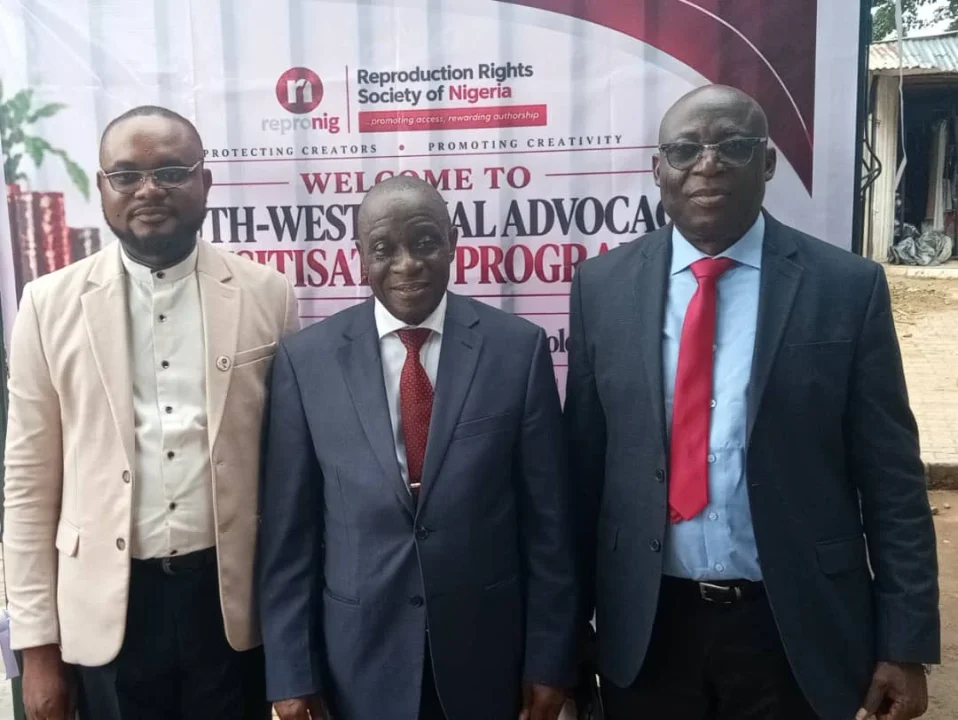
The South-West Zonal Advocacy and Sensitisation Programme, held at the U.I Ventures Mini Hall, University of Ibadan, attracted authors, publishers, librarians, lecturers, artists and representatives of higher institutions across Ekiti, Lagos, Ogun, Ondo, Osun and Oyo states.
The programme, themed ‘Nigerian Copyright Law and the Role of REPRONIG,’ is the fifth in the ongoing nationwide campaign covering all six geopolitical zones. Previous editions have been held in North-Central, North-West, South-South and South-East, with the final edition for the North-East scheduled to hold in Maiduguri.
Speaking with journalists on the sidelines, Chairman, Board of REPRONIG, Mr Gbadega Adedapo, said the essence of the zonal advocacy was to bridge the gap between policy and the people meant to benefit from it.
“We collect rights of the authors from institutions — we license the institutions. Because if you have a programme but the communities that are supposed to benefit from that assignment are not fully aware, it shows that they may not even subscribe to it,” Adedapo said.
“So, this programme is about the fifth one in Nigeria and all the six geopolitical zones are almost covered. It’s a welcome development for writers. Imagine you have your published work in institutions but students are the ones enjoying it and you’re not benefitting from it. But now, there is an organisation ready to assist you, not a private business per se. Because we have the Nigerian Copyright Commission regulating our activities. And the board members of REPRONIG comprise the authors, publishers, artists, among others. So the stakeholders in that ecosystem are well represented.”
A board member of REPRONIG and current President of the Nigerian Publishers Association, Alhaji Lukman Dauda, said the programme was designed to confront the culture of indiscriminate photocopying in academic communities.
“The essence is to bring to the awareness of the general public and particularly, those people living within the academic communities to know what REPRONIG stands for, what’s capable of doing, the benefits derivable from its activities, especially to content creators — authors and other creators of original thinking,” Dauda said.
“What we are trying to do here is to ensure that people who have laboured to bring about something for the benefit of humanity don’t do that in vain, especially in the academic community where the common thing is for people’s works, especially published articles, to just be reproduced without any hindrance. Such things definitely affect the benefits derivable by the original owners, he added.
Dauda said invitations were sent to 77 public and private universities and polytechnics across the South-West, with each institution asked to nominate two representatives. However, despite repeated follow-ups, only about 30 institutions, representing 39 per cent, responded. At the time of the event, 60 participants had joined online, while 40 attended physically.
“By bringing this programme up throughout the six geopolitical zones of the country, and this is the fifth one, and another one will be happening next week in Maiduguri, the underpinning is to let the original owners of these creative works know that there’s an organisation that is fighting for their interest and that their labour will not be in vain going forward,” he said.
“So, we are trying everything possible to get institutions of higher learning licensed and then to be able to make contributions towards this unauthorised reproduction of people’s works. And whatever is generated from such efforts will be shared among the original owners that have taken the pain to register and upload their works on the platform of REPRONIG. That’s the major reason for this programme,” Dauda added.
Acting Executive Director of REPRONIG, Mr Tosin Akeredolu, explained the legal mandate of the organisation as the sole Collective Management Organisation for reprographic rights in Niger
“The Reproduction Rights Society of Nigeria is the only collective management organisation in Nigeria that’s responsible for the administration and protection of secondary right in terms of reprography, that’s reproduction either through photocopy, through digital download, through scanning, through sharing on digital network and so forth,” Akeredolu said.
“By doing so, there’s a high tendency that the rights of those creators — authors, publishers, newspaper proprietors, artists, among others, might be infringed upon even without their permission. So, the government in its wisdom through the Nigerian Copyright Commission set up a body that’s licensed to monitor and also protect the rights of literary creators — right owners, right holders in the text and image-based sector. So, this sensitisation and awareness programme is for every stakeholder in the country to know their rights and to carry everybody along,” he added.
Deputy Director, Regulatory and Compliance Department, Nigerian Copyright Commission, Kunle Olatunji, who spoke on Nigerian Copyright Law and Reproduction Rights, said the Copyright Act 2022 had expanded protection into the digital space and now held Internet Service Providers accountable.
Speaking on the provisions, Olatunji noted, “The whole part of Copyright Act 2022 is devoted to copyright in the online environment. It also now has safeguards for tampering with any work in the online environment either by way of tampering with technological protection measures or removal of right management information.”
“It goes further to even make ISP responsible. And like I said earlier in my presentation, that provision is not only there, the Copyright Act now has the capacity to take down any infringing website wherever it is worldwide, and not just the work alone. For example, we are prosecuting the man behind NetNaija and that’s why you cannot see NetNaija anywhere. We are also prosecuting MovieBox online platform that distributes movies and what have you. So, if we can do that to those ones, then when it comes to the publishing industry, definitely the same rule will apply.”
On what ordinary Nigerians must do to avoid falling foul of the law, the NCC official was blunt: “Thou Shall Not Steal. Because if you used somebody’s work without permission, you’re essentially stealing.”
“So basically, we live in a country where the majority are not literate. Those of us who are literates pretend that we don’t see. That’s my experience for over 20 years in the industry.”
On Artificial Intelligence and intellectual property, Olatunji said AI had not altered the principle of authorship, explaining, “The protection of creatives in the realm of AI has not changed because copyright is essentially a human right, not a machine right. So, you cannot aggregate people’s works and do machine learning and start pushing it out. Each of those individuals whose works you’re dealing with under the cover of AI, they still have the original right. And the moment the commission discovers or we have a petition, we will go after you.”
He warned that penalties under the Copyright Act 2022 included asset forfeiture, fines, imprisonment or a combination, depending on the severity of the infringement.
Head of the Department of Library, Archival and Information Studies, University of Ibadan, Prof. Clement Akangbe, delivered his paper on Promoting Copyright Compliance in Libraries and Academic Institutions: The role of Librarians and Information Professionals.
The Director-General of the Nigerian Copyright Commission, Dr John Asein, was represented by Olatunji at the occasion.
Also present at the event were Prof. Tope Olaifa; the Managing Director of Stirling-Horden Publishers Limited, Prof. Andrew Okwilagwe; the current Chairman of the Association of Nigerian Authors, Oyo State Chapter, Dr Philomena Nwoko; Mrs Yomi Ogunlari; and other participants.