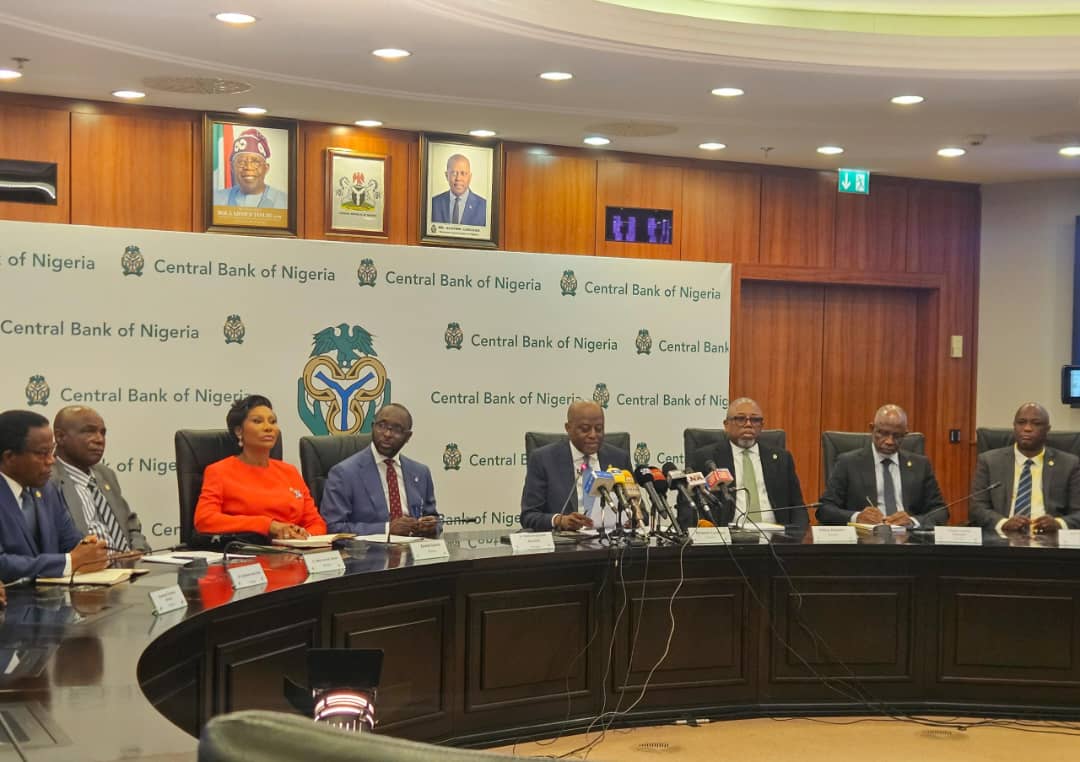
The monetary policy committee (MPC) of the Central Bank of Nigeria (CBN) has retained the monetary policy rate (MPR), which benchmarks interest rates in the country, at 26.5 percent.
Olayemi Cardoso, governor of the apex bank, announced on Wednesday at the end of the committee’s 305th meeting in Abuja
Cardoso said all 11 members of the committee attended the meeting where they reviewed recent developments in the global and domestic economies and assessed the near- to medium-term outlook.
He said the MPC also retained the asymmetric corridor around the MPR at +50/-450 basis points.
The committee further retained the cash reserve ratio (CRR) for deposit money banks at 45 percent, merchant banks at 16 percent, and non-TSA public sector deposits at 75 percent.
Cardoso said the MPC’s decisions were “anchored on a comprehensive assessment of risks to the outlook”.
“The MPC recognises its transitory nature and remains confident that the current macroeconomic environment is sufficiently robust to support a return to disinflation,” Cardoso said.
Speaking on the factors influencing the committee’s decision, the CBN governor said members noted the spillovers from the Middle East crisis, which have placed upward pressure on energy prices, transportation costs, and logistics globally.
“However, indications are that the impact of the crisis on the Nigerian economy has been minimal due to the benefits of prior policy reforms,” he said.
“These include exchange rate stability, improvements in external reserve buffers, strengthened monetary policy transmission, well-capitalised banking system, and ongoing fiscal consolidation, which have significantly bolstered the economy’s ability to absorb external shocks.”
Cardoso said the reforms have helped moderate the transmission of global price pressures into the domestic economy.
“As a result, the pass-through of global commodity and energy price shocks to domestic inflation has been significantly mitigated and would have been more pronounced in the absence of these reforms,” the CBN governor said.
“The MPC was therefore convinced that the essential conditions for price stability remain firmly in place.”
He also said the committee welcomed Nigeria’s recent sovereign rating upgrade despite prevailing external headwinds.
“This further underscores the strength of the country’s macroeconomic fundamentals and reinforces confidence in its reform trajectory and policy credibility,” Cardoso said.
According to the apex bank chief, members of the committee agreed that maintaining a cautious policy stance remains necessary to keep inflation expectations under control and sustain macroeconomic stability.
“Members were therefore of the view that a cautious and vigilant policy stance is necessary to anchor inflation expectations and safeguard macroeconomic stability,” he said
Cardoso also said the committee noted “with satisfaction” the successful conclusion of the banking recapitalisation exercise.